Writing to Persuade
June 18th, 2020I stopped posting here regularly after I went to work at the Boston Globe Sunday magazine (no fault of my employer). But I taught a class on freelance journalism earlier this year, and in encouraging my students to post regularly online, I got the itch to do so myself. Here goes something..
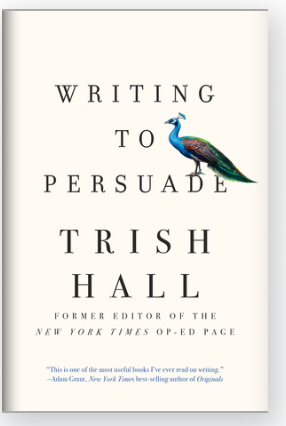
Gearing up to teach a journalism class, I realized my syllabus had almost no books on the craft of nonfiction writing by women. I had books by Bill Blundell, Roy Peter Clark, Jack Hart, Jon Franklin, etc. I started searching around for books on journalistic style that were written by well-known women journalists. I found good books by women on fiction writing and style, and lots of great works of journalism by women. But nothing about approach to the craft by a Susan Orlean or Isabelle Wilkerson or Jacqui Banaszynski, to name a few names I searched on.
I asked women journalists I work with for recommendations, and struck out there, as well. I finally went to Porter Square Books to, honestly, buy John McPhee’s Draft 4. And there, on the shelf, I found Writing to Persuade by Trish Hall. Hall was the one-time op-ed editor at the New York Times. That’s an excellent credential for the writer of such a book, so I bought it.
When she opened with “15 principles of Persuasive Writing,” I thought I might have made a mistake. Who can act on that many directives? Not me. But I kept going, and was rewarded.
I was inspired by her true comments, such as “No place with people is dull,” succor to my small town background, and the belief that I don’t have be in New York (say) to find a good story. Where The Elements of Style gave us William Strunk Jr., Hall gives us Mrs. Shortz, her 7th and 8th grade English teacher/mentor and style superhero (I was sad that Mrs. Shortz disappears after page 16).
I appreciated Hall’s discussion of becoming a writer, and learning to be an editor. The book is full of useful examples of how the Times edits its opinion pieces. Most writing books ignore the impact of editors; writers and reporters get the credit in our business; editors are mere gatekeepers to greatness. As Hall notes, “No one ever says, when she gets a compliment on a big story, ‘Oh, this was junk until my editor got ahold of it.’ ” No one ever says this because it feels terrible to admit. I can think of several stories I wrote that were salvaged only by excellent edits, but I’m not going to brag about those. Now that I’m again working as an editor, I will say that sometimes writers have problems translating what they know in a way that those of us who don’t can enjoy.
Hall, however, is thoroughly enjoyable to read, in part because she sneaks in surprises, things I have not seen in other writing books. One is a section on listening — brilliant! Some tips:
- Don’t express negativity while people talk.
- Don’t give advice.
- Don’t cut people off, or abruptly change the subject.
- Don’t look at your phone.
- Think about what is being said.
Listening, she writes, will help us understand other points of view, and force us to either modify our own beliefs or develop better ways to support them. “If you disdain the opposition, you will never persuade them of anything,” she writes. Listening helps us understand the reasons why other people think what they do; it forces us to know them, and that is the key to getting them to listen to us.
That leads her to a chapter on empathy, another bit of genius I don’t remember seeing in other books on non-fiction craft. Hall defines empathy not as merely identifying with another, feeling their pain. Instead, it “involves understanding the psychological makeup of other people.”
She notes research suggesting that empathy is waning. I think this will mean that those who can practice empathy will probably have the richest writing, and the broadest readership.
In sum, this book transformed my thinking about opinion writing. Before I read it, I thought an opinion piece is about what I want to say. I am now aware that truly effective opinion pieces — ones that don’t just rally the troops — acknowledge and even embrace those who disagree, or don’t care in the first place.
I am so glad I walked into that bookstore; it found for me what I could not drum up in a Web search.
 I went to Argonne National Laboratory to write for The Economist about the shift in Big Science in America. I was excited to go in part because I never went during my years at the University of Chicago, which runs the lab (and why would I go, since I didn’t study physics?). Argonne is where the atomic age was whelped, and helped end the second world war, so perhaps fitting that it was named for a copse of trees that evoked the battle that effectively ended World War I and was the major effort by American troops in that war. Argonne was the first of America’s 17 major
 Padel’s “The Miser” starts with a quote from Darwin’s Autobiography: “The passion for collecting, which leads a man to be a miser, a virtuoso, or a systematic naturalist, was very strong in me.”